
Level: Intermediate | TOPIK 3–4
On July 25, 2026, Kang Haneul successfully held his fifth fan meeting, “ALWAYS Season 3.”
Both Haneul and MC ORI mentioned that Haneul had spent a great deal of time redesigning the program. He wanted to create as many opportunities as possible to interact directly with fans, so he kept revising the schedule over and over until he was satisfied.
One of those interaction segments was “Haneul’s Advice Corner.”
It was filled with thoughtful, heartfelt answers, so I’d like to share what I remember.
(Recording was not allowed, so these are based on my memory.)
Questions from Fans
①How can I smile all the time like you?
②How can I learn to enjoy spicy food?
③Final consonants (batchim) are so difficult when learning Korean.
④I’m this cute, so why don’t I have a boyfriend?
⑤I have a boyfriend, but I still want to marry you. How can I make my boyfriend my number one?
⑦Should I pursue the job I love or choose an ordinary career?← Today’s Topic 💙
⑧Do you have any travel memories? (Asked in English by a fan from Germany.)
➉I came with my older sister, but we don’t get along. She stole my Kang Haneul hand fan!
What Haneul Really Meant by 잘못됐습니다

I’m wondering whether I should live my life doing what I love, or whether I should just live an ordinary life.
That was the concern shared by a middle-school student.
And Haneul’s very first words in response were unexpectedly sharp—so much
so that they caught me a little off guard.

솔직하게 제 생각을 말할게요.
Let me honestly tell you what I think.
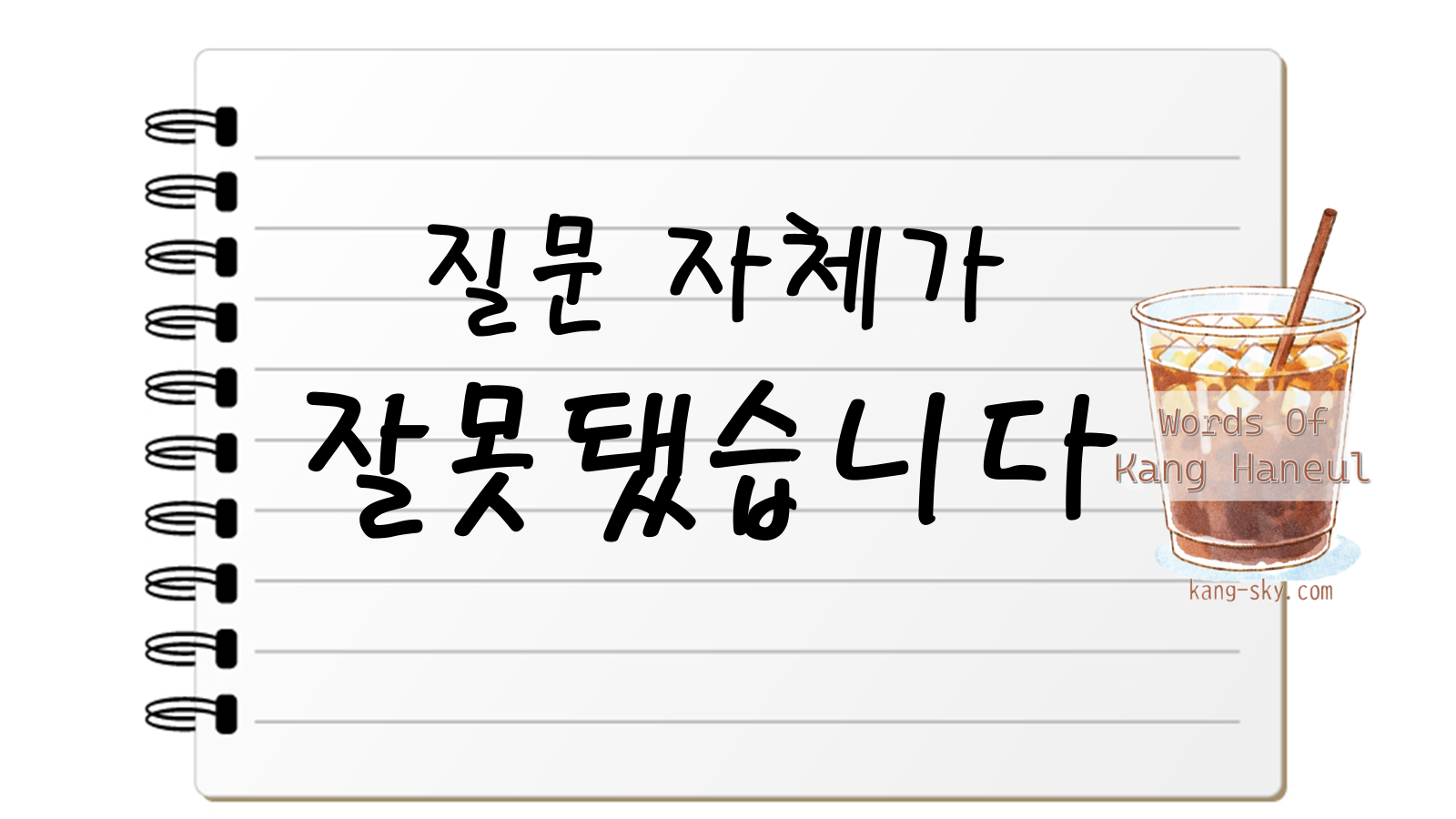
질문 자체가 잘못됐습니다.
The question itself is flawed.
Being told, right out of the blue, “The question itself is wrong” would make you a little nervous, wouldn’t it?
The expression used here, 잘못됐습니다 (jal-mot-dwaet-seum-ni-da), is often translated as “is wrong” or “is incorrect.”
잘못되다 means that something is in a state where it is not right, or that something has gone wrong or failed to work out properly.
However, in this particular sentence, 질문 자체가 잘못됐습니다 does not mean, “You asked the wrong question.”
The key point is that 질문 자체 (the question itself) is the subject.
In Japanese, saying “The question is wrong” can also sound like “The person asking the question asked something wrong,” but Haneul isn’t blaming the person who asked.
Rather, it has the sense of:
“The way you’re framing the question isn’t quite right in the first place.”
or
“The problem is treating those two things as your only choices.”
In other words, Haneul is not rejecting the questioner.
He is rejecting the premise behind the question.
The fan presented two choices: “Should I follow what I love, or should I live an ordinary life?”
But to Haneul, perhaps those two things simply don’t feel like opposing choices in the first place.
And that’s why he begins by saying 질문 자체가 잘못됐습니다
—turning the entire framework of the question upside down.
Then Haneul continues:
아, 성함이 어떻게 돼요?
Oh, what’s your name?
민영이요.(=가명)
I’m Minyoung. (a pseudonym)
민영 씨? 민영 씨가 좋아하는 일이 특별한 거예요.
Minyoung? The thing that you like is something special.
남들처럼 평범한 일을 할까요가 아니라
It’s not about whether you should do something ordinary like everyone else.
내가 좋아하는 걸 하는 것 자체가 특별한 거예요.
The very act of doing what you love is something special.
왜냐하면 민영 씨는 이 세상에 하나밖에 없잖아요.
Because there’s only one Minyoung in this whole world.
그래서 민영 씨가 하는 일이 특별한 일이에요.
So whatever Minyoung does is something special.
At this point, the audience bursts into applause and a wave of impressed reactions. 👏
And then, without missing a beat, Haneul says:
가 ㅁ 사 하 ㅂ 니다, 미 ㄴ 여 ㅇ 씨!
T-h-a-n-k y-o-u, M-i-n-y-o-u-n-g!
He breaks the words up into individual letters and syllables as a callback to the earlier batchim joke, making the audience laugh.
I mean… the fan is Korean, Haneul! 😂
Clementine’s Note 🍊Haneul’s Answer to Youngho’s Question
Listening to Haneul’s answer, I found myself thinking about something that has always felt very “Haneul” to me:
the idea that you are the protagonist of your own life.
You are the one living your life, making your choices, and walking your own path. And perhaps that is why Haneul didn’t seem to see the fan’s question as a choice between two completely different paths.
“Do I follow what I love, or do I live an ordinary life?”
Maybe, to Haneul, there is no such thing as an “ordinary path” in the first place.
Once you choose something for yourself and make it part of your life, that path becomes uniquely yours. And because it is yours, it becomes special.
That’s why, perhaps, whatever path you choose can become a special path—not because it looks extraordinary to other people, but because you chose it and made it your own.
There’s something wonderfully free-spirited about Haneul.
I also can’t help wondering whether the way he was raised had something to do with that openness. From the stories he has shared about his parents, it seems that they gave him plenty of freedom to make his own choices. They didn’t oppose or interfere with the things he wanted to try.
As Haneul has explained, their attitude was essentially:
“Try it. If it doesn’t work out, you’ll find another path.”
I think that way of thinking may have become a natural part of Haneul’s outlook on life:
Choose for yourself. Give it a try. And if it turns out not to be right for you, you can always choose another path.
Perhaps that is why the idea of choosing between “a safe, secure path” and “a path you love” didn’t seem like much of an either-or to him.
Maybe he simply doesn’t see life as something that has to be reduced to two choices.
If you choose a path for yourself and walk it in your own way, then even a path that looks ordinary to someone else can become something special to you.
And thinking about it that way made me look at 잘못됐습니다 a little differently.
Haneul wasn’t simply telling her, “That’s wrong.”
Perhaps what he was really saying was:
“You don’t have to think about your life as those two choices.”
And somehow, that feels very Haneul💙
A Thought That Took Me Back to Youngho
There was another reason this conversation stayed with me.
It reminded me of a question Youngho asks in Waiting for Rain:
사람은 좋아하는 일을 해야 될까요
“Should people do what they love?”
아니면 하는 일을 좋아해야 되는 걸까요?
“Or should they learn to love what they do?”
This is the question Youngho poses about choosing which path to take in life.
Should I follow what I love, or should I learn to love the life I have chosen?
The two conversations are different, of course. But both touch on the same underlying question:
How do we decide what kind of life to live?
And perhaps Haneul’s answer is that we don’t always have to choose between two neatly defined paths.
Sometimes, you choose something, try it, live it—and then see where it takes you.
If it turns out not to be right, you choose again.
Maybe that freedom to choose again is what makes a path truly your own.
And perhaps that is the real meaning behind Haneul’s 질문 자체가 잘못됐습니다.
Not:
“You’re asking the wrong question.”
But rather:
“You don’t have to limit yourself to the choices in that question.”
That is a very different kind of answer.
And, to me, a very Haneul kind of answer. 💙
Mini Korean Lesson: The Difference Between 잘못됐다 and 잘못했다
When it comes to spacing, both 잘못됐다 and 잘못했다 are normally written as a single word.
Spacing rules
잘못됐다 (○) / 잘못 됐다 (×)
잘못했다 (○) / 잘못 했다 (×)
In both cases, 잘못 combines with -되다 or -하다 to form a single verb, so there is no space between them.
One important exception: 잘 못 하다 / 잘 못 되다
When 잘 means “well” and 못 means “cannot / fail to,” they are three separate words:
잘 못 하다 / 잘 못 됐다
These mean things like:
- 잘 못 하다 = to be unable to do something well / to not do something well
- 잘 못 됐다 = something didn’t go well / something didn’t work out properly
So the spacing changes the meaning.
Difference in meaning and nuance
| Expression | Main meaning | Focus | Example |
|---|---|---|---|
| 잘못됐다 | to be wrong / incorrect / to have gone wrong | The state or result is wrong | 일이 잘못됐다. — Something went wrong with the work. 계산이 잘못됐다. The calculation is wrong. |
| 잘못했다 | to have done wrong / to have made a mistake / to be at fault | The action or responsibility is wrong | 내가 잘못했다. — I was wrong. / It was my fault. 훈육을 잘못했다. — I handled the discipline/parenting incorrectly. |
Even when there is no explicit subject, the basic difference in perspective remains the same.
잘못됐다 focuses on the state or result: something is wrong, has gone wrong, or turned out badly.
잘못했다 focuses on the action or responsibility: someone did something wrong or is at fault.
That distinction is especially important in Haneul’s sentence:
질문 자체가 잘못됐습니다.
The subject is 질문 자체, “the question itself.”
So Haneul is saying that the question/premise is wrong, rather than saying:
질문자가 잘못했습니다.
“The person asking the question was wrong.”
That is why 잘못됐습니다 works so well here.
Source of Haneul’s Words
Official title: KANG HA NEUL FAN MEETING in JAPAN 2026 “ALWAYS Season 3”
Date: Saturday, July 25, 2026
Venue: KT Zepp Yokohama, Yokohama, Kanagawa, Japan