
Level: Intermediate | TOPIK 3–4
On July 25, 2026, Kang Haneul successfully held his fifth fan meeting, “ALWAYS Season 3.”
Both Haneul and MC ORI mentioned that Haneul had spent a great deal of time redesigning the program. He wanted to create as many opportunities as possible to interact directly with fans, so he kept revising the schedule over and over until he was satisfied.
One of those interaction segments was “Haneul’s Advice Corner.”
It was filled with thoughtful, heartfelt answers, so I’d like to share what I remember.
(Recording was not allowed, so these are based on my memory.)
Questions from Fans
①How can I smile all the time like you?
②How can I learn to enjoy spicy food?
③Final consonants (batchim) are so difficult when learning Korean.
④I’m this cute, so why don’t I have a boyfriend?
⑤I have a boyfriend, but I still want to marry you. How can I make my boyfriend my number one?
⑦Should I pursue the job I love or choose an ordinary career?
⑧Do you have any travel memories? (Asked in English by a fan from Germany.)← Today’s Topic 💙
➉I came with my older sister, but we don’t get along. She stole my Kang Haneul hand fan!
No Advice Question This Time 😂
This time, the fan asking Haneul a question is from Germany.

 I don’t speak Korean.
And that’s how the exchange begins.

예스! (Yes)슈어! (Sure)오케이! (OK)
The audience immediately bursts into laughter.
It’s Haneul’s signature broken-English routine.
(To be fair, Haneul can probably speak a little more English than he lets on.
I suspect he actually enjoys playing up the “I can’t speak English” character!)
The German fan continues:
I just wanted to say that I came from Germany to Japan just to see you.
Oh~~~Germany?
At this point, ORI, the MC, gives Haneul a quick translation.

 ドイツからハヌルさんに会うために日本に来られたそうです。
She came all the way from Germany to Japan to see you.
 “어? 영어도 잘하시네요?”
Oh? You’re good at English as well, huh?
いえいえ、大体聞いた感じで言ってるだけですよ~!
No, no! I’m just saying what I understood from listening to her!
So, I just want to ask if you have any travel memories?
Yeah, oh, umm, 여행에 대한 추억이 있냐는 거죠?
Yeah, oh, umm… You mean, do I have any travel memories?
And then,
어~, 어~, 영어 선생님 계시죠?
Um… um… there’s an English teacher here, right?
At this point, Haneul remembers that during the VIP rehearsal viewing earlier that day, someone had asked a question and introduced herself as an English teacher.
선생님 정확히 뭐라고 하신거죠?
Teacher, what exactly did she say?
And just like that, the English teacher is suddenly called upon as an interpreter.
The teacher translates into Japanese from her seat.
But Haneul doesn’t understand Japanese, so presumably the dedicated interpreter listening through his in-ear monitor then translates it from Japanese → Korean for him.
At this point, Haneul’s ears are already working much harder than the audience’s.
And from the audience, the teacher’s voice is difficult to hear and the overall view isn’t great either.
So the English teacher is invited onto the stage.
And the German fan comes up too.
せんせい、どうぞ。
Sensei, please come up.
He suddenly sounds like the MC himself.
Now, four people are standing on stage.

And now, the chaos begins. 😂
From this point on, three languages start flying back and forth:
Korean, Japanese, and English.
I’m not sure whether the English teacher actually understood Korean, but for the purposes of this exchange, everyone proceeds on the assumption that she doesn’t.
어~제일 좋았던 곳은요~
(Japanese interpretation needed.)

えーと、一番よかった所はですね~
(English interpretation needed.)

So, the best place was…
The audience bursts into laughter at the sheer speed and busyness of the translations happening on stage. 😂
There is almost a collective feeling of:
“Wait… is this chaos going to continue?”
And somehow, that creates this wonderful sense of shared excitement among everyone in the room.
아르헨티나가 제일 좋았던 것 같아요.
(Japanese interpretation needed.)
アルゼンチンが一番よかったなと思っています
(English interpretation needed.)
I think Argentina was my favorite.
Yes, Argentina was good👍
Haneul has switched to English himself.
No interpreter needed for him this time. 😂
Then—
어~독일은 가보지 못했지만 꼭 가보고 싶어요.
And just like that—
back to Korean.
The in-ear interpreter translates it into Japanese.
ドイツには行ったことないんですけど、ぜひ行きたいです。
(English interpretation needed.)
I’ve never been to Germany, but I’d love to go.
The entire audience erupts into laughter and applause once again at the sheer whirlwind of the situation.
Thank you, thank you very much. 감사합니다.
The two fans return to their seats.
와~ 이런 것도 추억이죠.
Wow… this is a memory too, right?
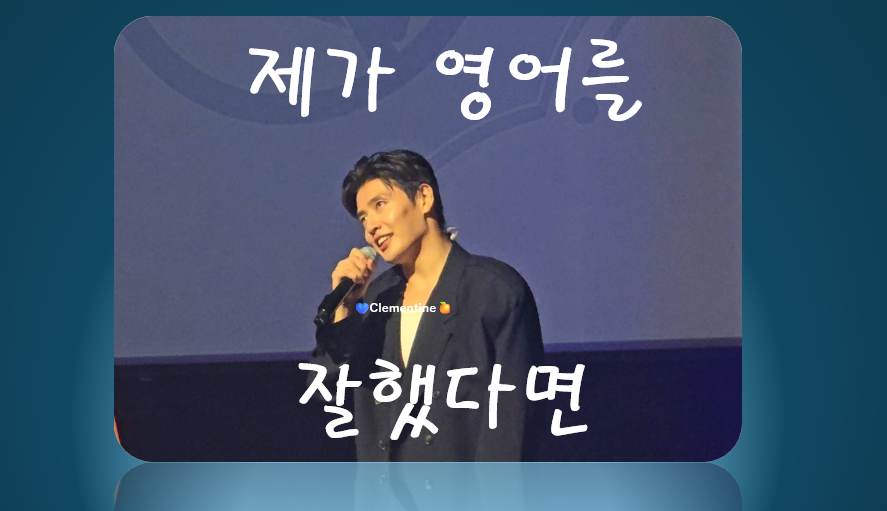
제가 영어를 잘했다면 이런 재미있는 일은 안 생기는 거예요.
If I were good at English, something this funny wouldn’t have happened.
And finally:
제가 영어를 못하는 게 다행이라고 생각해요.
I think it’s actually lucky that I can’t speak English.
Clementine’s Note🍊
This is Haneul’s positive mindset in a nutshell.
He has a talent for finding the good side in even the smallest mishap—or the most chaotic situation.
There’s a Korean saying:
말 한마디로 천 냥 빚도 갚는다.
Literally, “A single word can repay a debt of a thousand nyang.”
In other words, the way you put something into words can completely change how it is received.
And Haneul takes that idea to another level.
There is so much to learn from the way he reframes things.
I often think that even if he hadn’t become an actor—
whatever he had chosen to do—
he probably would have succeeded.
A positive mindset attracts positive things.
Haneul seems to embody that idea like sunshine itself. 🌞
Haneul’s “If I Were Good at English”잘했다면 vs. 잘했으면
There is one Korean expression in Haneul’s comment that is particularly interesting:
제가 영어를 잘했다면
Both 잘했다면 and 잘했으면 can sometimes be translated as “if I were good at it” or “if I had been good at it.”
But the nuance is different.
잘했다면
-다면 is used to imagine a hypothetical situation:
“If that were the case…”
“If I had been good at English…”
It presents a situation as a condition—often one that is different from reality.
For example:
영어를 잘했다면 이런 재미있는 일은 안 생겼을 거예요.
If I had been good at English, something this funny wouldn’t have happened.
Here, Haneul is imagining an alternative reality:
If I had been good at English → this funny situation wouldn’t have happened.
The important point is that this is a hypothetical situation, not a wish.
잘했으면
-으면 can also express a condition, but 잘했으면 is especially common in expressions of hope or desire:
영어를 잘했으면 좋겠어요.
I wish I were good at English.
It would be nice if I were good at English.
Here, the speaker is expressing a wish or something they would like to be different.
However, 잘했으면 does not always mean “I wish.”
Depending on the context, it can also express a hypothetical condition:
영어를 잘했으면 이런 재미있는 일은 안 생겼을 거예요.
This can also mean:
If I had been good at English, this funny situation wouldn’t have happened.
So the context matters.
Why did Haneul say 잘했다면?
In Haneul’s actual comment:
제가 영어를 잘했다면 이런 재미있는 일은 안 생기는 거예요.
he is imagining:
“If I had been good at English, this funny situation wouldn’t have happened.”
That hypothetical situation leads directly to his wonderfully Haneul-like conclusion:
“So I’m actually glad I can’t speak English.”
In other words:
If I had been good at English → this chaotic, funny moment wouldn’t have happened → therefore, maybe it’s actually a good thing that I’m not good at English.
That little twist is what makes the comment so characteristically Haneul.
Instead of seeing his lack of English ability as a disadvantage, he turns it into the reason a memorable and funny moment happened.
And somehow, even an accidental three-language translation disaster becomes a good memory💙
Source
Official title: KANG HA NEUL FAN MEETING in JAPAN 2026 “ALWAYS Season3”
Date: Saturday, July 25, 2026
Venue: KT Zepp Yokohama, Yokohama, Kanagawa, Japan