

Level: Intermediate | TOPIK 3–4
Today, I’m introducing behind-the-scenes footage from Yadang, the film that became a major hit in the Korean movie industry in 2025.
This time, Haneul puts aside his usual “refreshingly nice guy” image and takes on the slightly wild, bad-boy role of Lee Kang-su. But when the cameras aren’t rolling, he’s still the Haneul we all know and love.
Video highlight: Why is he moving his head up and down…?
During the interview, Haneul keeps moving his head up and down for some reason.
Despite his cool outfit, his movements are completely “naturally goofy Haneul” (lol).
Let’s find out why he’s moving like that while listening to his explanation!
여러분 안녕하십니까?
Hello, everyone.이강수역할의 강하늘입니다.
I’m Kang Haneul, playing the role of Lee Kang-su.여기는 극중의 호텔에서 파티가 이루어지는데 그 파티에서 불순한 일이 일어난다고 해서 제가 잠입해서 그 상황을 찍는 장면을 찍고 있습니다.
This is a scene set in a hotel in the film, where a party is being held. Something suspicious is said to happen at that party, so I infiltrate it and film what’s going on.
“목 운동 중?”
Doing neck exercises?
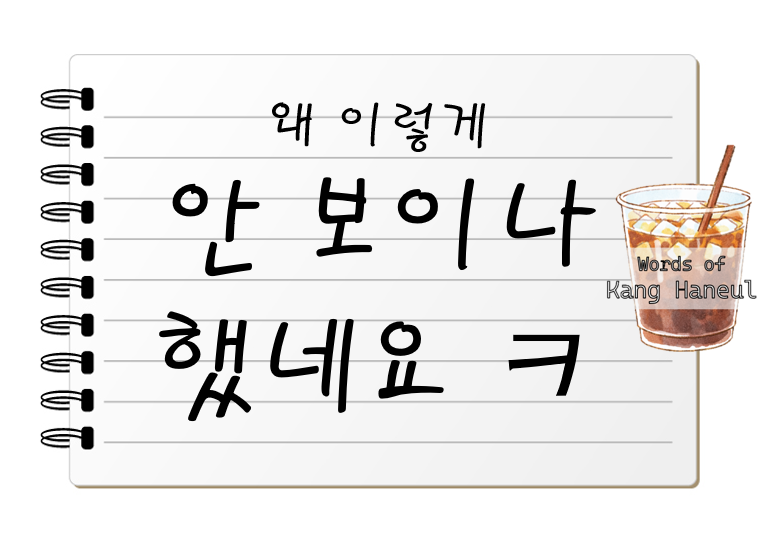
왜 이렇게 안 보이나 했네요 ㅋㅋㅋㅋㅋ
I was wondering why I couldn’t see very well, lol.
제가 지금 밤에 왜 선글라스를 끼고 있나? 너무 멋뿌리는 거 아니냐? 얘기하실 수 있는데ㅋㅋㅋㅋ
You might be wondering why I’m wearing sunglasses at night, or thinking, “Isn’t he trying a bit too hard to look cool?” lol.
이게 특수 제작된 우리 소품팀에서 직접 만들어 주신
These were specially made by our props team.
이렇게 뽑아서
You take it out like this,
여기에 이제 SD 카드를 넣고 이렇게 꽂아서
put the SD card in here,
이렇게 꽂아서
and insert it like this.
네, 하면 여기에 카메라가 있다.
Then, there’s a camera right here.
요런 상황 안에서 찍었다 생각해 주시면 더 재밌게 보실 수 있을 것 같습니다.
If you imagine that it was filmed under these circumstances, I think you’ll enjoy watching it even more.
전 그러면 촬영을 해야 돼서 요거 쓰고 머리 한번 넘기고 갈게요. 하나, 둘, 셋.
I need to get back to filming now, so I’ll put this on, flip my hair once, and head out. One, two, three!
Today’s Korean
Here are some key words I picked from Haneul’s interview today!
| Korean | Pronunciation | Meaning | Usage in the text |
|---|---|---|---|
| 이루어지다 | iroeojida | to take place | 파티가 이루어지는데 (A party is taking place…) |
| 일어나다 | ireonada | to happen | 불순한 일이 일어난다고 (Something suspicious is said to happen…) |
| 잠입 | jamip | to infiltrate / sneak in | 제가 잠입해서 (I sneak in…) |
| 상황 | sanghwang | situation | 그 상황을 찍는 (Filming that situation…) |
| 찍다 | jjikda | to film / shoot | 장면을 찍고 있습니다 (I am filming a scene.) |
| 장면 | jangmyeon | scene | 찍는 장면을 (The scene where [I] film…) |
| 뽑다 | ppopda | to pull out / remove | 이렇게 뽑아서 (You pull it out like this…) |
| 꽂다 | kkotda | to insert / plug in | 이렇게 꽂아서 (You insert it like this…) |
| 넘기다 | neomgida | to flip back / sweep (hair) | 머리 한번 넘기고 (After flipping my hair once…) |
An expression you’ll want to use
This is a super handy phrase you can use in everyday conversation when you want to say something like
“You know when you think, ‘Oh, so that’s why!’” or “I was wondering why…”
왜 이렇게 안 보이나 했네요 Wae irokke an boina haetneyo
Meaning:
“I was thinking, ‘Why can’t I see anything so well?’”
The key part of this expression is the sentence ending “-na haetneyo (〜나 했네요)”.
It’s used when something initially feels strange or puzzling, and then you realize the reason and think to yourself, “Ah, that’s why!” or “Now it makes sense.” It has the nuance of a little remark you mutter to yourself as you come to terms with the situation.
In this case, Haneul is making a lighthearted self-comment—either reacting to the fact that he himself is wearing sunglasses and everything looks dark, or imagining how viewers might respond—saying something like, “Even I found myself thinking, ‘Why is it so hard to see?’” 😄
The key point of this expression
The heart of this phrase is the sentence ending 〜나 했네요.
It’s used when:
- something felt strange or confusing at first, and
- you suddenly understand the reason and think,
“Ah, that’s why!” / “Now it makes sense.”
It sounds like a little mutter to yourself, but it can also be said with the listener in mind, as if sharing that moment of realization.
In this interview, Haneul says it while realizing that he himself is wearing sunglasses and can’t see well — or while imagining how viewers might react. It’s basically a gentle self-commentary, like:
“Even I found myself thinking, ‘Why is it so hard to see?’” 😄
It’s a useful expression when you want to sound like you’re talking to yourself, or when you want to convey that feeling of “Ohhh, now I get it.”
- “I was wondering what was going on.”
(after realizing why it was noisy outside)
→ 무슨 일인가 했네요. Museun iringa haetneyo. - “I thought it was someone else!”
(but it turned out to be a friend)
→ 누군가 했네요. Nugunga haetneyo. - “I was wondering why it suddenly got so dark.”
(when it starts raining all of a sudden)
→ 왜 이렇게 어둡나 했네요. Wae ireoke eodupna haetneyo.
Maybe Haneul’s signature “naturally innocent” vibe comes from these honest little thoughts that just slip out without him even trying 😊
멋뿌리는 거 아니냐? (Mopppirineun geo aninya?)
Meaning:
“Aren’t you just trying to look cool?” / “Aren’t you showing off a bit?”
The verb 멋부리다 means to dress up, to put on airs, or to try to look cool. It’s often used jokingly with close friends.
The key point here is the sentence ending –아니냐?.
Grammatically, it’s a question directed at someone else, but in this scene, Haneul is actually teasing himself, as if thinking, “Isn’t this how people are probably seeing me right now?”
He’s playfully turning the situation on its head—imagining people thinking,
“Sunglasses at night? Is he trying to look cool or what?”
—and then commenting on himself with humor, almost from an outside perspective:
“Doesn’t it look like I’m just trying to act cool?”
By the way, in the interview he doesn’t pronounce it as 멋부리는(meot buri neun), but as 멋뿌리는(meot ppuri neun), using a tense (strong) consonant. This kind of pronunciation is often used in casual Korean when someone is joking around or adding emphasis, giving the line an even more playful, cheeky tone.
💡 The difference between “아니냐?” and “아니야?”
Both mean “Isn’t it…?”, but there’s a reason Haneul chose 아니냐? here.
Grammatical role (what comes after)
Because the word “얘기 (talk / comment)” follows, the sentence takes the form of a question inside a quoted clause:
~아니냐? (Isn’t it…?)
In Korean, a question inside a quoted statement is commonly used like this:
- ∼아니냐고 얘기하다
= to say / comment, “Isn’t it…?”
In this case, the particle 고 is omitted.
This omission is very common in spoken Korean.
- 아니냐? 얘기하실 수 있는데
→ “You might say / comment, ‘Isn’t it…?’”
Why not “아니야?”
If 아니야? were used instead, it would sound like a self-contained mutter or standalone question, more like pure self-talk. That makes it a bit awkward to connect naturally to what follows—namely, “the idea / comment that someone might make.” 💦
So here, 아니냐? works better because it smoothly leads into a quoted or reported remark, rather than ending the thought on the spot.
★Quick explanation★
Haneul uses “아니냐?” instead of “아니야?” not only because it naturally leads into a phrase like “people might say / the idea that…”, but also because it sounds a bit more masculine and playful—like giving himself a cheeky nudge and saying, “Isn’t that the case, huh?” or “Doesn’t it look that way?”
It carries a light, teasing tone, as if he’s talking back to himself, which adds to that charming, mischievous nuance.
Clementine’s Note📒
Haneul’s slightly airheaded, natural side is something every fan can’t help but find adorable, right?
At his core, he’s such a genuinely good-hearted person that no matter how sharp his gaze was in the film Yadan, a certain unmistakable purity still shone through. In the end, the fact that he couldn’t fully become a true villain somehow feels so like him🤣
Now imagine this: “slightly bad-boy Haneul” and “naturally innocent Haneul” appear in front of you at the same time…
Could you really choose which one you’d want to spend time with?
As for me…my imagination has already completely run wild 💓