


Level: All Levels | TOPIK All Levels
Today, September 30, is International Translation Day.
So I thought I’d take a closer look at the English titles of films and dramas featuring Kang Haneul🎬
When I line up their original Korean titles, I find words and images I hadn’t noticed from the English titles alone.
Korean, for example, has several ways of addressing someone: 너, 그대, 당신.
In English, these can all become you, even though they don’t have quite the same feeling in Korean. Sometimes, that “you” disappears altogether.
This time, I’m looking at the titles from three angles: replacing, adding, and leaving out.
(He’s been in way too many things… I can’t fit them all in.’s been in way too many things… I can’t fit them all in.)
Replacing: Is “You” Always the Same “You”?
너는 펫 (2011) → You’re My Pet
너 is an informal way of saying “you,” generally used with someone close to you or someone younger. Depending on the relationship and tone, it can sound affectionate, casual, or confrontational.
The English you doesn’t make those distinctions by itself. We pick them up from context and the way someone speaks.
There’s another small difference here: 너는 펫 literally means “You are a pet,” but the English title adds my.
There is no 내 or 나의, meaning “my,” in the Korean title. That little word makes the relationship more explicit in English: you’re not just a pet, you’re my pet.
The film is based on the Japanese manga Kimi wa Pet. The Japanese and Korean titles mean essentially the same thing: “You are a pet.” The English title makes the relationship more explicit by adding “my.”
아름다운 그대에게 (2012) → To the Beautiful You
This drama is also based on the Japanese manga Hanazakari no Kimitachi e, literally “To You in Full Bloom.”
The Japanese title explicitly addresses a plural “you” (君たち), while the Korean title uses 그대, without an explicit plural ending.
The Japanese title explicitly addresses a plural “you” (君たち), while the Korean title uses 그대, without an explicit plural ending.
And this 그대 has a different feel from the 너 we saw in You’re My Pet: it’s more lyrical, a word that fits naturally into poetry and song lyrics.
But the difference between 너 and 그대 is harder to see in English. Both become “you,” while “beautiful” helps carry the romantic feeling here.
Also, 그대 has no explicit plural ending. English you can address one person or several, so that distinction remains open in the English title too.
당신의 맛 (2025) → Tastefully Yours

Now we come to 당신, another Korean word for “you.”
당신의 맛 literally means “Your Taste.” But 당신 isn’t the everyday equivalent of English “you”: it can be used between spouses, in arguments, and in literary writing, among other contexts. Calling a stranger 당신 simply because you don’t know their name can sound confrontational.
The English title, Tastefully Yours, takes a different route.
Tastefully usually means “with good taste,” in the sense of style or judgment. In a drama about food, though, it also brings the flavour-related meaning of taste to mind.
And yours echoes affectionate letter endings such as “Yours” or “Yours truly.”
So rather than translating each word directly, the English title brings together food, good taste, and a little romantic warmth. It’s quite a clever title, I think.
Interestingly, “you” hasn’t completely disappeared here. It has changed into yours.
Adding: When the English Title Offers an Explanation
미생 (2014) → Misaeng: Incomplete Life

Some English releases use the fuller title Misaeng: Incomplete Life.
Misaeng preserves the sound of 미생, while Incomplete Life gives English-speaking viewers a clue to its meaning.
The Korean word comes from baduk, the board game also known as Go. It refers to stones that have not yet secured life: they are not safely alive, but they still have the possibility of surviving.
That makes it a fitting image for the people in this drama, still trying to find their place in the working world.
Unlike a completely new promotional subtitle, Incomplete Life explains the meaning already contained in 미생.
The English title keeps the unfamiliar Korean word and adds a way into it. I like that we get both the original sound and a hint of what lies behind it.
Leaving Out: When Words Disappear from the English Title
비와 당신의 이야기 (2021) → Waiting for Rain
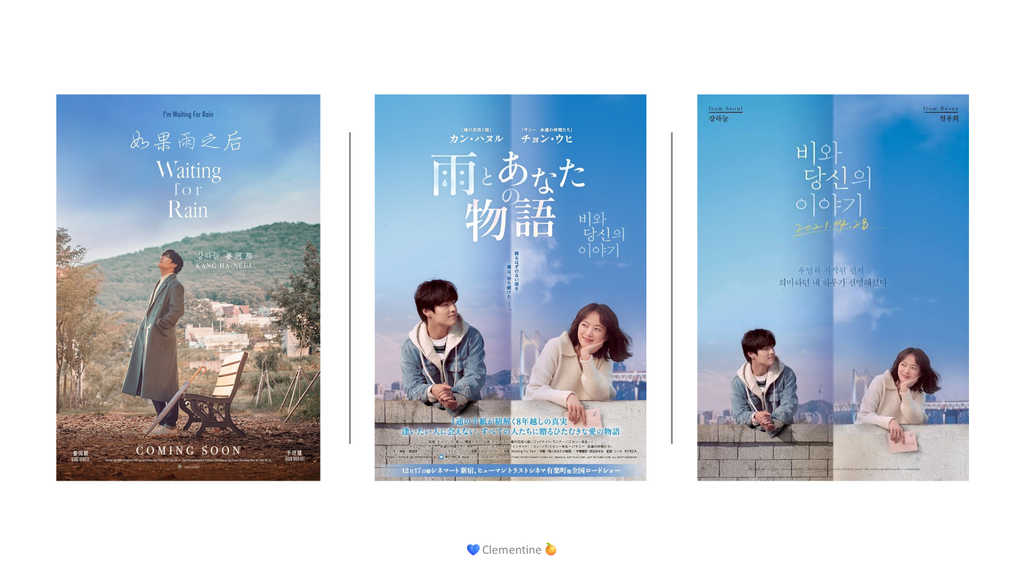
The Korean title literally means “The Story of Rain and You.”
But the English title is Waiting for Rain.
당신, “you,” disappears, along with 이야기, “story.” In their place, we get the idea of waiting.
The Korean title alone gives us no hint that waiting for rain is part of the story. It simply puts rain and a person side by side. The English title brings that waiting to the foreground.
For a film about people connecting through letters, I feel that the two titles lead us into the same story with slightly different expectations.
One makes me wonder, “Who is this ‘you’?” The other makes me wonder, “Why are they waiting for rain?”
커튼콜: 나무는 서서 죽는다 (2022) → Curtain Call
This drama was initially known as 나무는 서서 죽는다, meaning “Trees Die Standing.” A Yonhap report from April 2022 confirms that earlier title.
The phrase also matches the title of Spanish playwright Alejandro Casona’s play, Los árboles mueren de pie: “Trees Die Standing.”
The image of a tree remaining upright until the end suggests, to me, holding on to dignity even when life is coming to a close.
The longer Korean title 커튼콜: 나무는 서서 죽는다 brings that image together with Curtain Call, the moment when performers return to the stage after a performance.
The English title is simply Curtain Call.
There’s an important detail here: the title also changed during the Korean production process. So the shorter English title isn’t necessarily the result of an English translator independently removing the phrase.
Still, comparing it with the earlier and longer Korean titles reveals an image that English-speaking viewers might otherwise miss.
Knowing those words makes Curtain Call feel a little different to me.
해적: 도깨비 깃발 (2022) → The Pirates: The Last Royal Treasure
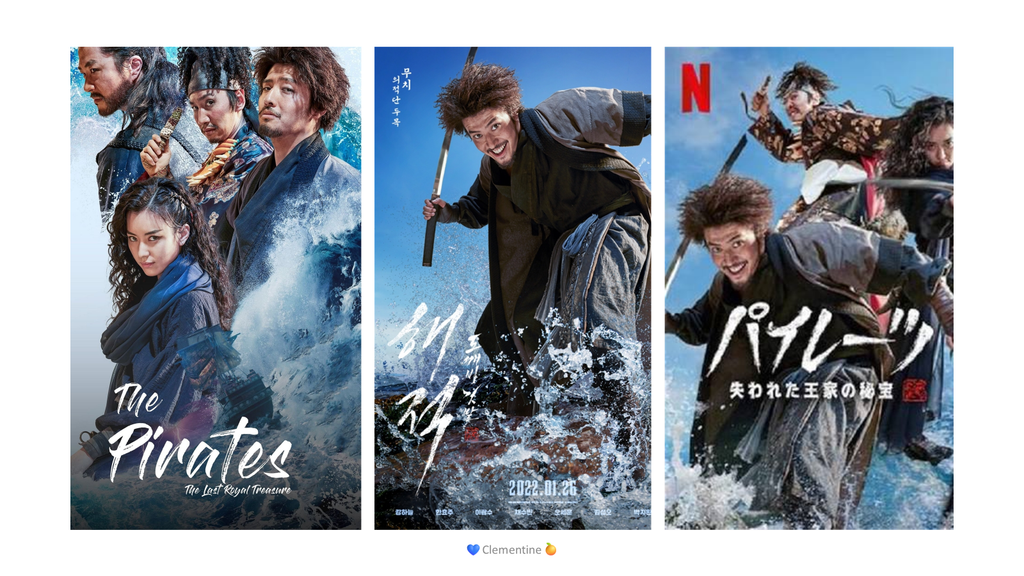
Here, the subtitle is replaced rather than simply removed.
해적 means “pirates,” while 도깨비 깃발 means “The Dokkaebi Flag.”
A dokkaebi is a supernatural being from Korean folklore. In folk tales, dokkaebi may challenge people to wrestling matches, play tricks, or bring wealth through a magical club. They have more sides to them than the image of a frightening monster alone suggests.
The English word goblin is often used as a translation, but it doesn’t carry exactly the same cultural associations.
“The Dokkaebi Flag” leaves us with a culturally specific, mysterious image. The Last Royal Treasure tells us more directly what kind of adventure awaits: a hunt for royal treasure.
I haven’t found an official explanation saying that the difficulty of translating 도깨비 caused the title change. But comparing the two titles, I can see how differently they introduce the film.
One offers a mysterious flag. The other offers a treasure to chase.
Clementine’s Note🍊
너 and 그대 both become “you.” 당신 becomes “yours” in one title and disappears in another. 미생 keeps its Korean sound, with an English explanation alongside it.
Looking at these words individually is a little Korean lesson. Putting the titles side by side also shows us different ways of introducing a story.
Since Kang Haneul’s next film is 국제시장2, I also wanted to look at the title of the first film, 국제시장, known in English as Ode to My Father.
The Korean title refers to Gukje Market, a market located in Busan. The English title shifts our attention from a place to a tribute to a father. Maybe it’s because I’m not Korean, but I think I’m a little more drawn to the English title.
A place name can carry atmosphere and memories for people who know it. For an audience unfamiliar with that place, another title may offer a different way into the story.
Starting with the English title, going back to the Korean, and sometimes visiting the Japanese title too… the more I look, the more interesting title translation becomes.
Perhaps knowing a few different titles can even change what we notice when we watch 🎬
하지원, KBS 새 드라마 ‘커튼콜’ 합류…강하늘과 호흡 2022-04-25