
Level: Pre-Intermediate | TOPIK 2–3
Level: Beginner–Intermediate [Approx. TOPIK 2–4]
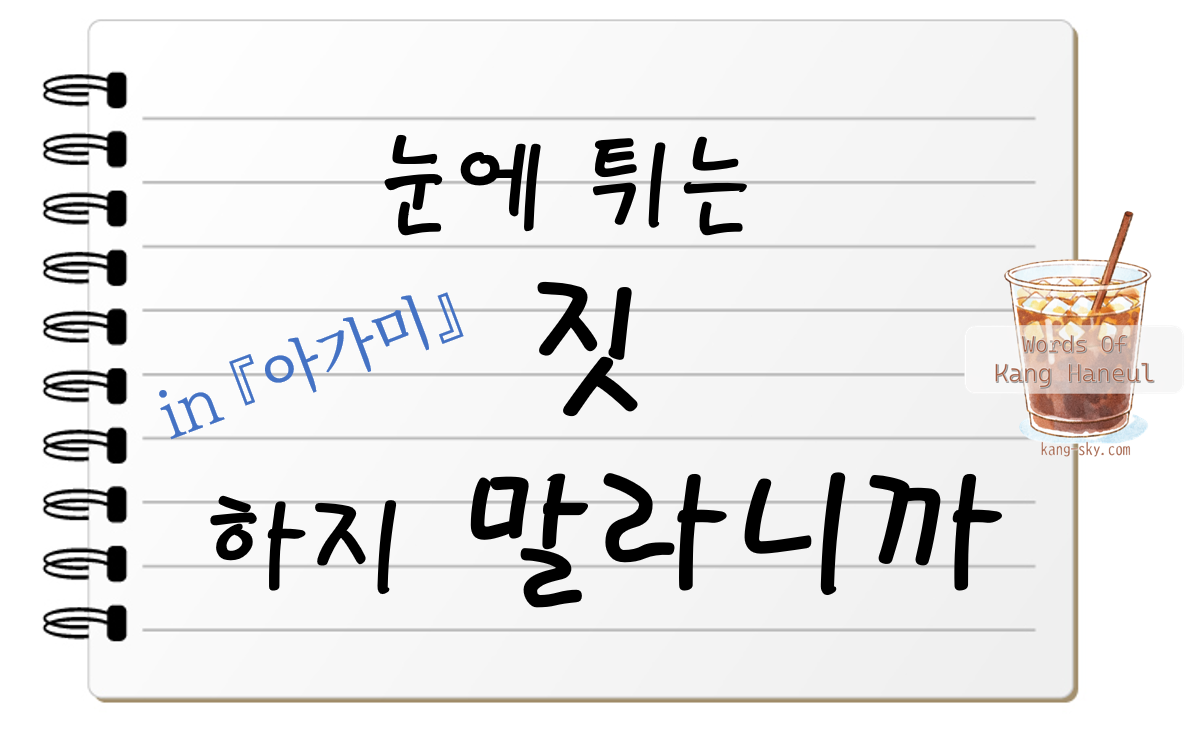
눈에 튀는 짓 하지 말라니까
In the animated film Gill (아가미), Kangha (강하), voiced by Kang Haneul, says this to Gon (곤):
눈에 튀는 짓 하지 말라니까.
A natural English translation would be:
“I told you not to do anything that draws attention.”
“I told you not to do anything that makes you stand out.”
It is quite a strong way of speaking.
Gon loves swimming and sometimes goes out to swim in the water, putting himself at risk of being noticed by other people.
So Kangha repeatedly warns him:
눈에 튀지 말라니까.
But he is not simply angry.
If Gon is discovered, he will no longer be able to live a peaceful life.
So behind Kangha’s harsh words is also a desire to protect Gon.
눈에 튀다 = “to stand out”
The verb 튀다 can have quite a few meanings on its own.
Its basic image is something popping out, bouncing, or splashing.
For example:
- 물이 튀다 → water splashes
- 기름이 튀다 → oil splatters
- 공이 튀다 → a ball bounces
- 밖으로 튀어나오다 → to pop / jump out
In 눈에 튀다, the literal image is something jumping into your eyes.
From there, it comes to mean:
to stand out / to catch the eye / to be noticeable
빨간 옷이라서 눈에 튀어요.
You stand out because you’re wearing red.
사람이 많은 곳에서는 눈에 튀지 않는 게 좋아요.
It’s better not to stand out in a crowded place.
What does 짓 mean?
짓 is a noun meaning:
an act / behavior / something someone does
However, compared with a neutral word like “behavior,” 짓 often carries a slightly negative or disapproving tone.
It can feel like:
“that kind of thing”
“that sort of behavior”
For example:
바보 같은 짓
something stupid / a stupid thing to do
위험한 짓
something dangerous / a dangerous thing to do
So:
눈에 튀는 짓
means,
“something that draws attention”
or
“anything that makes you stand out.”
What makes Kangha’s wording sound so harsh?
The key is that he does not simply say:
눈에 튀지 마.
Instead, he says:
눈에 튀지 말라니까.
-지 마
= don’t do ~
When it becomes -지 말라니까, it adds the feeling of:
“I told you not to…”
“I keep telling you not to…”
“How many times do I have to tell you?”
There is frustration and insistence in it.
Compare:
눈에 튀지 마.
Don’t stand out.
눈에 튀지 말라니까.
I told you not to stand out.
The second one sounds much stronger.
Try saying these while sounding annoyed ↓
혼자 가지 말라니까.
I told you not to go alone.
위험한 짓 하지 말라니까.
I told you not to do anything dangerous.
밖에 나가지 말라니까.
I told you not to go outside.
Try it yourself
Translate the following into Korean:
① I told you not to stand out.
② I told you not to go alone.
③ I told you not to do anything dangerous.
Answers
① 눈에 튀지 말라니까.
② 혼자 가지 말라니까.
③ 위험한 짓 하지 말라니까.
Clementine’s Note🍊
눈에 튀지 말라니까.
Kangha says similar things to Gon again and again throughout the film.
At one point, he completely loses his temper and snaps:
몇 번 말해!
“How many times do I have to tell you?!”
Seriously, how many times did he say it? lol
His words are harsh, but the reason he keeps repeating them is because he is trying to protect Gon.
And at the same time,
it also feels as though Kangha is desperately trying to protect his own heart—
a heart that has become stiff, guarded, and constantly tense.
And then there is one more thing that makes me smile.
Kangha and Gon have a relationship that feels almost like an older brother constantly lecturing his younger brother.
But in real life,
Kang Haneul is actually two years younger than Jung Haein, who plays Gon.
The more I think about that, the funnier it gets💙
Where the phrase comes from
Film: Gill (아가미)